 Drew Lindeman


FAQ: what steel thickness can be processed on a bradbury leveler?
Bradbury manufactures a heavy duty leveler and shear capable of processing one inch thick material.
In sheet metal processing, two machines often get confused with each other: coil straighteners and levelers. Both are used to improve sheet flatness, one more capable than the other. Understanding these differences is crucial for successful manufacturing.
Steel, as well as other sheet metals stored in coil form, experiences uneven stress. When the coil is uncoiled and curvature is retained after uncoiled, this is called a coil set. Crossbow is a curvature across the width of the strip where the sheet forms a smile or frown shape due to stress differences through the faces or top and bottom surfaces of the strip. Edge wave and center buckle are length differences in the strip. When edges are longer than the center of the strip, this is referred to as an edge wave. The opposite occurs when the center is longer than the edges and is referred to as center buckle.
While similar, levelers and straighteners address different issues. A coil straightener is primarily used to remove the coil set or crossbow. Feeding the metal strip through rolls that bend the strip up and down uniformly across the face. This reduces the internal stress created when the metal is coiled. A properly sized straightener eliminates the coil set or crossbow caused by the coiling to prepare for further processing. Straighteners focus on surface-to-surface stress and cannot fix uneven lengths across the strip exhibited as an edge wave or center buckle.
Levelers provide a more advanced form of sheet metal flattening. Levelers can remove coil set or crossbow like straighteners but can also correct the length differences.
Using closely spaced rolls allowing for greater bend angle, these rolls can be flexed under load to allow the machine to create areas of a longer path for the strip. The bending actions on the rolls allow the leveler to stretch specific areas of metal, equalizing length, and stress to provide a flat strip. Levelers correct defects that straighteners cannot, such as edge waves and center buckles.
Although coil straighteners and levelers look similar, their capabilities are different. Properly sized straighteners can remove coil set or crossbow, while levelers can do this and improve the overall flatness of the material by correcting length issues as well.
The Bradbury Company has been building and improving hydraulic levelers since the mid 1980s. Since then, Bradbury levelers have become the most versatile and efficient metal flattening machine available. With brute hydraulic force, focused tension, and power at the point of plasticity we equalize stress delivering premium flatness day after day. World-class controls, automatic leveler adjustment, and unique options have made our levelers easy to operate and continue to be the most productive roller leveler available.
To learn more please visit Bradbury Group Roll Forming and Coil Processing Equipment
We Build Machines. We Sell Solutions.
+1.620.345.6394.
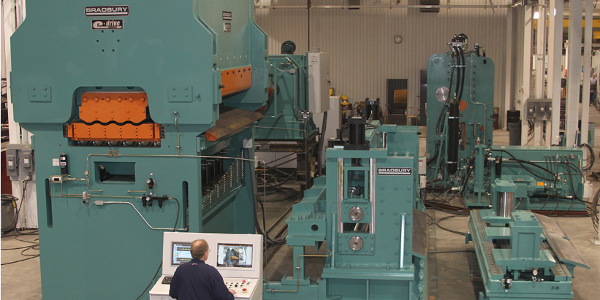
Bradbury manufactures a heavy duty leveler and shear capable of processing one inch thick material.

Jim Sugars with The Bradbury Group will present "When Flat isn't Flat - Equalizing Internal Stresses Through Roller Leveling" at the SEAISI...
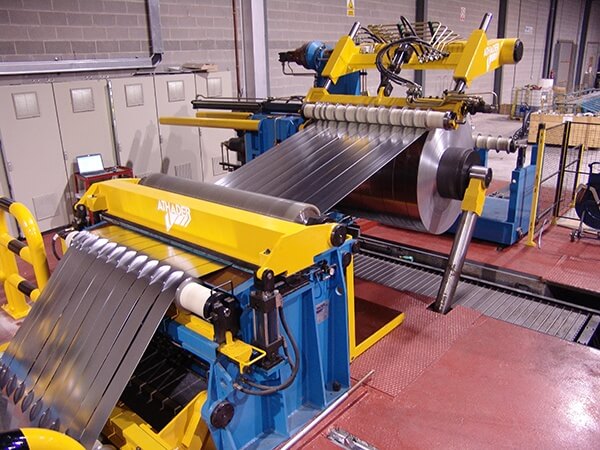
Join The Bradbury Group at the 2018 FMA Coil Processing Workshop to discover the advanced features of slitting lines and other coil processing...